admin
admin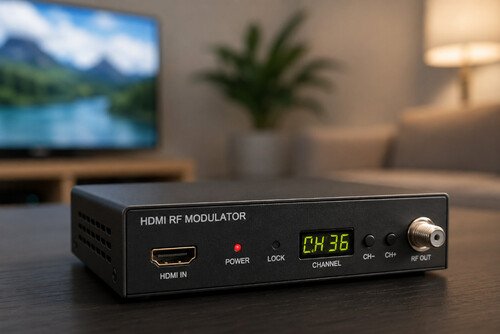
In modern audio-video installations, the need to distribute high-quality content to multiple televisions or displays is becoming increasingly common. Homes, hotels, schools, offices, retail spaces, healthcare facilities, and public venues often require one video source to be available on many screens at the same time. While HDMI is one of the most popular standards for transmitting digital video and audio, it is mainly designed for direct connections over relatively short distances. This is where HDMI RF modulators become useful. An HDMI RF modulator is a device that converts an HDMI signal into a radio-frequency signal that can be sent through coaxial cable. Thanks to this conversion, content from a modern HDMI source can be distributed through existing TV cabling and received by televisions as a regular channel. This makes HDMI RF modulators an important solution in systems where many displays need access to the same video content without installing separate HDMI cables for each screen. This article explains what HDMI RF modulators are, how they work, where they are used, and why they remain relevant in both residential and commercial video distribution systems.
What Are HDMI RF Modulators?
HDMI RF modulators are devices that convert an HDMI video and audio signal into a radio-frequency signal that can be distributed through coaxial cable and received by televisions as if it were a normal broadcast channel. In simple terms, they take the output from a modern digital source, such as a media player, set-top box, camera system, game console, or computer, and transform it into a signal that can travel through the same type of cable traditionally used for antenna or cable television distribution.
These devices are especially useful in buildings where coaxial cabling is already installed. Instead of running new HDMI cables to every television, an HDMI RF modulator allows one HDMI source to be sent to multiple TVs over existing coaxial infrastructure. Each television can then tune to a specific channel to view the content.
The Basic Idea Behind RF Modulation
To understand HDMI RF modulators, it helps to separate the two main parts of the term: HDMI and RF.
HDMI stands for High-Definition Multimedia Interface. It is a digital connection used to carry high-quality video and audio between devices. HDMI is common in modern home entertainment systems, commercial displays, security systems, presentation equipment, and digital signage setups.
RF stands for radio frequency. RF signals are used to transmit television, radio, wireless communication, and many other types of broadcast data. In the context of television systems, RF signals are commonly carried over coaxial cables. A television tuner can receive these signals and decode them into picture and sound.
An HDMI RF modulator acts as a bridge between these two worlds. HDMI is designed for short-range point-to-point digital connections, while RF is designed for distribution across a wider system. By converting HDMI into RF, the modulator makes it possible to send modern digital content through traditional television cabling.
How an HDMI RF Modulator Works
The process inside an HDMI RF modulator involves several steps. First, the device receives an HDMI input from a source. This input contains digital video and audio. The modulator then processes the signal, encodes it into a television-compatible format, and assigns it to a channel frequency.
Once the signal is modulated, it exits the device through an RF output, usually using a coaxial connector. From there, it can be sent directly to a television, connected to a splitter, or integrated into a larger coaxial distribution system.
On the receiving end, the television does not need an HDMI connection to access the content. Instead, it uses its internal tuner to scan for channels. Once the channel created by the modulator is found, the HDMI source appears just like a standard TV channel.
This is one of the biggest advantages of HDMI RF modulation: it allows many televisions to receive the same source without requiring individual HDMI cables or separate media devices for each screen.
Common Uses of HDMI RF Modulators
HDMI RF modulators are used in many different environments. In homes, they can distribute the signal from a single media device to several televisions. For example, one source in a living room or equipment cabinet can be made available in bedrooms, kitchens, or other rooms through coaxial wiring.
In hotels, RF modulators may be used to distribute welcome channels, information screens, or entertainment feeds to guest rooms. In schools and universities, they can send educational content, announcements, or live event coverage to displays throughout a campus. In offices, they may support internal communication channels, meeting room displays, or digital signage.
They are also widely used in security and surveillance systems. A camera recorder or monitoring station with HDMI output can be converted to an RF channel and viewed on televisions in different locations. This allows staff to monitor camera feeds without needing dedicated HDMI cabling to each screen.
Sports facilities, houses of worship, healthcare buildings, retail spaces, and public venues may also use HDMI RF modulators to distribute live video, announcements, presentations, or promotional content.
Why Use RF Instead of HDMI Cables?
HDMI cables are excellent for connecting devices over short distances, but they have practical limitations. Standard HDMI cables are not ideal for long-distance distribution, especially when a signal must reach multiple rooms or floors. Longer HDMI runs may require boosters, extenders, or network-based solutions, which can add cost and complexity.
Coaxial cable, on the other hand, is often already installed in many buildings. It is durable, relatively easy to split, and designed for signal distribution. An HDMI RF modulator takes advantage of this existing infrastructure.
Another important benefit is scalability. If a signal is distributed as an RF channel, many televisions can access it simply by tuning to the correct channel. This makes RF modulation useful when the same content must be shown on many screens at once.
For example, a single video source can be sent to dozens of TVs through a properly designed coaxial system. Without RF modulation, each TV might need its own player, receiver, or dedicated HDMI extension path.
Digital and Analog RF Modulation
Not all RF modulators are the same. Older modulators often produced analog television signals. These were suitable for older TVs but had lower image quality and fewer features. Modern HDMI RF modulators usually create digital RF channels.
Digital modulation offers better picture quality, improved sound, and more efficient signal handling. Depending on the television standard used in a particular region, the modulator may output a digital terrestrial, cable-style, or other channel format. The TV must support the same tuning standard in order to receive the signal.
This is an important point: an HDMI RF modulator must be compatible with the television system used in the installation area. Different countries and regions use different broadcast standards. Before using a modulator, it is necessary to confirm that the output format matches the tuners in the televisions.
Channel Selection and Frequency Planning
An HDMI RF modulator usually allows the user to choose the channel or frequency where the signal will appear. This is important because the modulated signal must not interfere with existing television channels or other RF signals in the system.
In a simple setup with only one modulator, channel selection may be straightforward. The installer chooses an unused channel, connects the device, scans the TV, and stores the channel. In larger systems, frequency planning becomes more important.
Multiple HDMI RF modulators can be used together, each creating a different channel. For example, one channel might show a security feed, another might show a digital signage playlist, and another might show a live event broadcast. Each modulator must be assigned a unique frequency so the channels do not overlap.
A well-planned RF system can carry many channels over a single coaxial network. However, poor planning can cause interference, weak signals, or tuning problems.
Picture Quality and Resolution
HDMI RF modulators can support different resolutions, depending on their design. Common supported resolutions include standard definition and high definition formats. Some units may accept higher-resolution HDMI inputs but output them at a lower broadcast-compatible resolution.
The final picture quality depends on several factors: the quality of the HDMI source, the encoding process, the selected bitrate, the RF output quality, the condition of the coaxial cabling, and the tuner inside the television.
A good modulator can produce a clear and stable picture, but RF distribution is not always identical to a direct HDMI connection. Encoding and modulation may introduce slight delay or compression. For most applications, such as signage, monitoring, education, and general video distribution, this is usually acceptable. For applications requiring extremely low latency or perfect image fidelity, other distribution methods may be more appropriate.
Audio Support
HDMI carries both video and audio, and an HDMI RF modulator typically embeds the audio into the RF channel along with the video. The television receives the channel and plays the sound through its normal speakers or connected audio system.
Audio compatibility depends on the supported formats of the modulator and the receiving TV. In many cases, standard stereo audio is used because it is widely compatible. Some systems may support more advanced audio formats, but the practical choice often depends on what all televisions in the system can reliably decode.
For public display systems, stereo audio or even muted video may be sufficient. For home entertainment, audio quality may be more important, so compatibility should be checked carefully.
Installation Considerations
Installing an HDMI RF modulator can be simple or complex depending on the system. A basic setup may involve connecting an HDMI source to the modulator, connecting the RF output to a TV, selecting a channel, and scanning for that channel.
Larger installations require more attention. The coaxial network may include splitters, amplifiers, taps, wall plates, and long cable runs. Each component affects signal strength. If the RF signal is too weak, televisions may not receive the channel reliably. If it is too strong, it can also cause problems. Proper signal level balancing is important.
Cable quality also matters. Damaged, old, or poorly shielded coaxial cable can reduce performance. Connectors should be properly installed and tightened. Splitters should be suitable for the frequency range being used.
In buildings with existing television services, care must be taken when inserting a new RF channel into the system. The new channel should not conflict with existing channels, and the combined signal levels should remain within acceptable limits.
Advantages of HDMI RF Modulators
The main advantage of HDMI RF modulators is efficient distribution. They allow one HDMI source to be viewed on many televisions using coaxial cable. This can reduce the need for extra source devices, long HDMI cables, or complex extension systems.
Another advantage is simplicity for the viewer. Once installed, the content appears as a regular TV channel. Users do not need to switch inputs or learn a complicated system. They simply select the correct channel.
HDMI RF modulators are also useful in retrofit projects. Many older buildings already have coaxial wiring but may not have modern network or HDMI distribution infrastructure. A modulator can make use of what is already there.
They also support centralized control. A source device can be located in one secure area, while the signal is distributed throughout the building. This is helpful for maintenance, security, and content management.
Limitations and Challenges
Despite their benefits, HDMI RF modulators have limitations. One limitation is that most installations distribute the same content to all televisions tuned to that channel. If different rooms need different content, multiple modulators or other distribution methods may be required.
Another limitation is compatibility. The modulator’s output standard must match the televisions’ tuners. A mismatch can prevent the TVs from finding or displaying the channel.
There may also be some delay due to video encoding. This delay is usually small but can matter in live performance, gaming, or interactive applications. Additionally, compression may reduce image quality compared with a direct HDMI connection.
HDMI copy protection can also be a consideration. Some HDMI content sources use protection systems that may restrict conversion or redistribution. Installers must ensure that their use case is legally and technically supported.
HDMI RF Modulators vs. Other Distribution Methods
HDMI RF modulation is only one way to distribute video. Other methods include HDMI splitters, HDMI extenders over network cable, video-over-IP systems, wireless transmission, and dedicated media players at each display.
Each method has strengths. HDMI splitters are simple for short distances. Network-based systems can offer flexible routing and high quality. Local media players can allow each display to show different content. Wireless systems can reduce cabling needs in some environments.
RF modulation is strongest when many televisions need access to the same channel-based content and coaxial cable is already available. It is especially practical when the goal is to add custom channels to a TV distribution system.
Conclusion
HDMI RF modulators are practical devices that convert modern HDMI signals into television channels carried over coaxial cable. They connect digital sources with traditional RF distribution systems, making it possible to send video and audio to multiple televisions without running separate HDMI cables to each screen.
They are used in homes, hotels, schools, offices, public venues, security systems, and digital signage installations. Their key benefits include efficient signal distribution, use of existing coaxial infrastructure, easy channel-based viewing, and centralized source management.
At the same time, successful use requires attention to compatibility, channel planning, signal levels, resolution, audio format, and legal content restrictions. When chosen and installed correctly, an HDMI RF modulator can be a reliable and cost-effective way to distribute HDMI content across a large television system.